
What If Christianity Is True?
One of the greatest challenges Christians face today is knowing how to start conversations about faith. We want to share the hope we have in Christ, but sometimes we aren’t sure where to begin. While the message of Jesus is always the foundation, there are helpful tools that can open doors to deeper discussions. One of those tools comes from a brilliant thinker named Blaise Pascal.
Pascal was a seventeenth-century mathematician, scientist, inventor, and Christian philosopher. He is famous for what became known as Pascal’s Wager—an argument designed to help people think rationally about belief in God.
For the record, Pascal’s Wager doesn’t save anyone…faith in Jesus Christ saves. However, Pascal’s idea can help remove barriers and create conversations that lead people toward considering the claims of Christianity.
The Simple Logic of Pascal’s Wager
Pascal asked people to think about two possibilities:
Either God exists, or He doesn’t.
Then he suggested considering the outcomes.
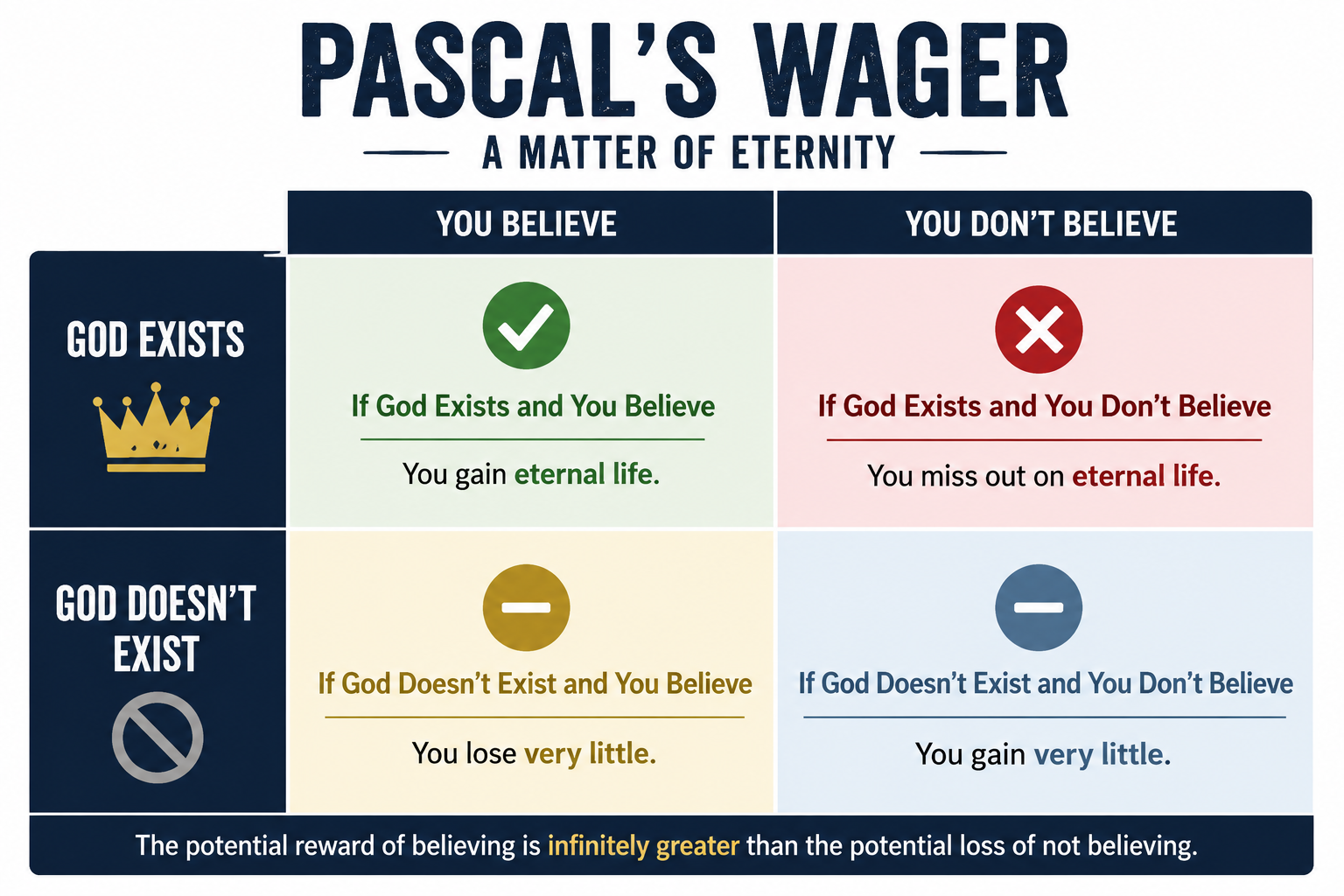
If God Exists and You Believe
You gain eternal life.
If God Exists and You Don’t Believe
You miss out on eternal life.
If God Doesn’t Exist and You Believe
You lose very little.
If God Doesn’t Exist and You Don’t Believe
You gain very little.
Pascal’s conclusion was simple:
If there is even a possibility that God exists, the potential reward of believing is infinitely greater than the potential loss of not believing.
Pascal was asking: “What is the risk of putting your faith in God compared to the risk of rejecting Him?”
Why This Matters
Many people today reject Christianity without ever seriously examining it. They dismiss God without asking the deeper questions of life:
- Why am I here?
- What happens after death?
- Is there purpose behind existence?
- Where does morality come from?
- Why do I long for something greater?
Pascal’s Wager forces people to pause and think. It moves the conversation from emotion to consideration. Instead of arguing, it asks a simple question: “Have you thought about what is at stake if Christianity is true?” That question alone can open incredible doors.
A Tool, Not the Destination
One mistake Christians can make is thinking that winning an argument is the same as winning a soul.
It’s not.
Pascal’s Wager is not the Gospel. The Gospel is that Jesus Christ lived the sinless life we could never live, died on the cross for our sins, and rose again so that whoever believes in Him may have eternal life.
Pascal’s Wager simply helps create a bridge. Think of it like knocking on the front door before entering a house. The wager gets someone’s attention. The Gospel changes their heart.
The Real Issue Is the Heart
Some critics argue that Pascal’s Wager encourages people to believe for selfish reasons.
That’s a fair concern. After all, God isn’t looking for people who simply want heavenly insurance. He desires a genuine relationship. However, many people first come to faith because they begin asking difficult questions. Fear of judgment, curiosity about eternity, or a desire for meaning can all become catalysts that lead someone toward Christ.
A Conversation You Can Have
The next time someone says they don’t believe in God, consider asking:
“Can I ask you a question? If Christianity turned out to be true, what would that mean for you?”
Notice that you’re not attacking.
You’re not debating.
You’re inviting them to think.
You might even explain Pascal’s Wager and ask: “If there is even a chance that God exists, isn’t it worth investigating?”
Most people have never seriously considered that question.
Pascal’s Wager is not the finish line—it is the starting line. Use it as a conversation starter. Use it as a bridge. Use it as a way to encourage someone to consider the claims of Christ seriously.
But never stop there. Point people to Jesus. Because at the end of the day, Christianity is not about making the safest bet. It’s about knowing the Savior who gave everything for us.
As believers, we should never be afraid of honest questions. Faith grows when it is examined, and truth always stands up to sceptics. What we focus on determines the direction of our lives. When people begin focusing on the possibility of God, they often discover the reality of God. Faith begins when we are willing to consider what God might be saying to us and then respond accordingly.







Please note: I reserve the right to delete comments that are offensive or off-topic.